
The Bitcoin Investment Handbook & Masterclass
Limited to 17 Seats.

A Professional Framework for Evaluating Bitcoin
Bitcoin is no longer an issue financial advisors can simply ignore. Clients own it. Clients ask about it. Spot Bitcoin ETFs have made exposure readily accessible through conventional brokerage and advisory accounts. Whether an advisor ultimately recommends Bitcoin, declines to recommend it, or limits its use to particular clients, that decision should rest on a disciplined investment framework.
The Bitcoin Investment Handbook & Masterclass is designed specifically to provide that framework. It approaches Bitcoin as an investment professional would approach any unfamiliar asset: determine what creates value, identify the risks, examine the available evidence, establish an appropriate valuation framework, understand portfolio behavior, evaluate implementation alternatives, and document a reasoned investment decision.
The Fiduciary Problem
Bitcoin presents an unusual challenge for investment advisers. It does not fit neatly into the analytical framework used for equities, fixed income, real estate, or traditional commodities. It has no cash flows, no issuer, no balance sheet, no central management, and no conventional fundamental valuation model. Yet dismissing it solely because those traditional tools do not apply is not analysis. A fiduciary needs to answer more useful questions:
What economic function does Bitcoin perform?
Why might it have value?
What evidence supports or contradicts that thesis?
How should its risks be classified?
How can its value be estimated?
How has it behaved within a diversified portfolio?
What forms of exposure are available?
What allocation, if any, could be justified?
And perhaps most importantly: How do you explain and defend that conclusion to a client, investment committee, compliance professional, or regulator?
That is the purpose of this program.
What You Will Be Able to Evaluate
The program provides a structured framework for examining Bitcoin rather than a predetermined conclusion about whether an investor should own it.
You will examine:
Investment thesis. What Bitcoin is economically, what problem it attempts to solve, and the mechanisms through which monetary value could emerge.
Valuation. Network economics, adoption models, Metcalfe's Law, scarcity, monetary demand, and the distinction between market price and estimated fundamental value.
Risk. Volatility, drawdowns, protocol risk, custody risk, exchange risk, regulatory risk, governance risk, technological replacement, leverage, and operational failure.
Portfolio construction. Bitcoin's historical return characteristics, diversification properties, position sizing, rebalancing, risk budgeting, and the consequences of different allocation levels.
Implementation. Direct ownership, spot Bitcoin ETFs, trusts, miners, related equities, custody arrangements, and the trade-offs inherent in each structure.
Market structure. Mining, proof of work, settlement, forks, transaction fees, liquidity, and the mechanisms that matter to an investor.
Adoption and network effects. How network growth can influence utility, adoption, and value over time.
Macroeconomic use cases. Bitcoin's proposed roles as a monetary asset, inflation hedge, crisis asset, treasury reserve, and alternative store of value—and the evidence for and against each proposition.
Fiduciary decision-making. How to move from research to a documented investment conclusion that can be explained to clients and investment committees.

This Is Not a Cryptocurrency Course
The program is not built around trading, token speculation, technical jargon, or predictions about where Bitcoin's price goes next. It is an investment-analysis course. The objective is to give professional investors the conceptual and quantitative tools necessary to independently assess Bitcoin using standards comparable to those applied elsewhere in portfolio management. The appropriate conclusion may differ by investor. The analytical process should not.
The Bitcoin Investment Handbook
Every participant receives The Bitcoin Investment Handbook, a 976-page professional reference designed for investors, fiduciaries, analysts, and investment managers.
The Handbook brings together monetary economics, computer science, cryptography, network economics, valuation, portfolio construction, and risk management within one analytical framework
What’s Inside
The definitive guide to Bitcoin investing—so investors can evaluate, value, and allocate to Bitcoin with institutional discipline. Comprehensive in every respect, this book has something for everyone.
The Bitcoin Investment Handbook helps professional investors clearly understand sources of value, elements of risk, portfolio role, and implementation considerations.
Instead of relying on headlines, price charts, or promotional claims, readers get a disciplined way to judge Bitcoin with evidence. Major scientific and economic frameworks are brought together so investors can understand and evaluate:
• What Bitcoin is and why it has value
• Whether fixed supply can support durable monetary value
• What can break: protocol risk, custody risk, exchange risk, and governance risk
• How proof of work, mining, settlement, and forks affect investment judgment
• How network growth, adoption curves, and monetary design support valuation
• What price, value, utility, liquidity, and risk imply for position sizing
• Trade-offs among spot Bitcoin, ETFs, trusts, miners, and related equities
• How Bitcoin changes portfolio construction, rebalancing, and risk budgeting
• How to evaluate Bitcoin across inflation, crisis, treasury, and reserve use cases
• How to justify the decision for clients, committees, and fiduciaries


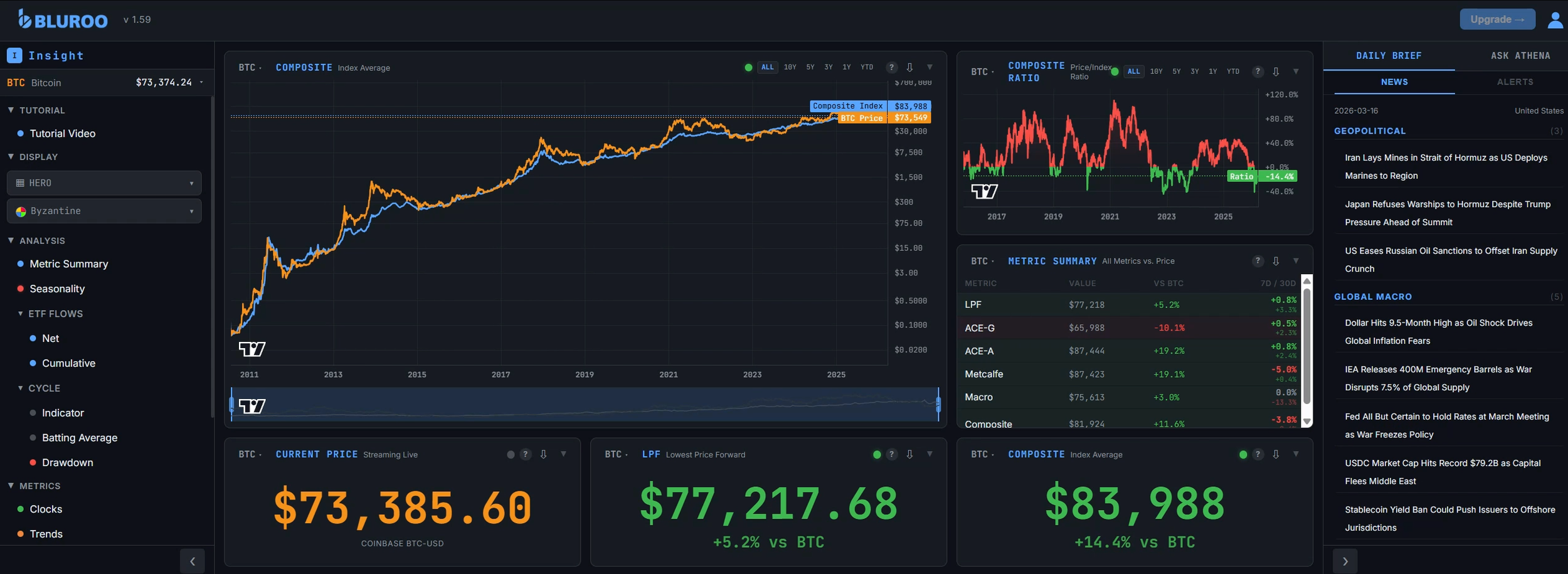
Your book comes with a subscription to Bluroo.ai, with current model readings, adoption metrics, fair-value estimates, and the quantitative signals derived from the frameworks in the book. BluRoo runs 24/7.
About Timothy F. Peterson, CFA, CAIA
Timothy F. Peterson has 30 years of institutional asset-management experience and has served on two investment committees. For approximately a decade, he managed Bitcoin-themed exposure in client portfolios, working within real-world investment objectives, portfolio constraints, suitability requirements, compliance expectations, client concerns, and regulatory oversight.
That experience directly informs this course. The material goes beyond theory to incorporate lessons learned from evaluating Bitcoin in actual portfolios: determining when exposure was appropriate, sizing positions, managing risk, explaining decisions to clients, operating within fiduciary constraints, and navigating the practical issues that arise between investment research and implementation.
Peterson has researched Bitcoin investment and valuation for more than a decade. He authored the first peer-reviewed methodology applying Metcalfe's Law to Bitcoin valuation, helping establish network economics as a framework for analyzing digital-asset value. His research has been accessed by investors in more than 100 countries, and SSRN ranks him among the top 0.2% of authors worldwide across all subjects.
He created and taught two MBA-level courses focused on Bitcoin, blockchain, digital assets, and network economics. For seven years, he has also taught professional-development coursework for financial-services professionals at the Graduate School of Banking at LSU.
His work has appeared in Forbes, Newsweek, Yahoo Finance, Investing.com, CoinDesk, and Cointelegraph, and he was featured in Mastering Crypto Assets.
Peterson holds degrees in finance and economics from the University of Colorado and completed the Investment Decisions and Behavioral Finance program at the Harvard Kennedy School of Government.